/s3:solidaritytech/images/landscape-default.jpg)
Content
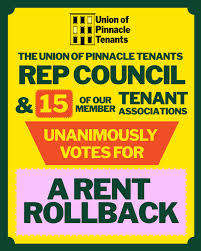
Union of Pinnacle Tenants, along with 62 Tenant Unions and Organizations, Demand Rent Reduction for All Rent-Stabilized Tenants
May 7, 2026
(New York, NY) — The Union of Pinnacle Tenants (UPT) has joined dozens of tenant unions, tenant associations, and organizations across New York City in calling on the Rent Guidelines Board to implement a meaningful rent reduction for rent-stabilized tenants.
The Representative Council of the Union of Pinnacle Tenants, alongside 15 of our member Tenant Associations, signed on in support of a rent rollback.
UPT members know firsthand what happens when landlords are allowed to raise rents while buildings fall apart. Our members have lived through mold, rodents, broken heat, and years of neglect — all while Pinnacle Group collected rent and grew its portfolio. The RGB's own data confirms what tenants have always known: landlord incomes are rising, and tenants are paying for it.
We are proud to stand alongside this coalition in demanding that the RGB do what the data demands: cut rents.
Contact: pinnacletenantsnyc@gmail.com
Rent Rollback Letter
To the Rent Guidelines Board:
We, the undersigned, write to demand a meaningful rent reduction for rent-stabilized tenants, alongside a broader effort by the City to reassess landlord cost and profit structures.
For far too long, landlords have been sitting on mountains of profits while our buildings are falling apart. When landlords raise our rent, that money goes to line their pockets and buy new buildings, not fixing our homes.
In spite of having access to city-funded tax abatements and repair assistance programs, landlords still keep many apartments vacant across their portfolios. This landlord poverty narrative creates space for abusive large landlords to push false claims of poverty and reduce services. And it lays the groundwork for future lobbying to de-regulate subsidized housing.
At the March 26, 2026 Rent Guidelines Board (RGB) meeting, the Board’s own data showed that landlord incomes are not in crisis. The RGB’s Income and Expense Study found that from 2023 to 2024, Net Operating Income (NOI) increased by 6.2% citywide, following large increases in prior years. Rental income rose 4.8%, outpacing operating cost increases of 4.2%.
This is a pattern spanning several decades. As former RGB Executive Director Timothy Collins has shown using the Board’s own data, rent increases authorized over time have gone beyond what was needed to keep landlords whole. His analysis finds that since 1990, RGB-approved increases were over 30% higher than what would have been required to cover operating costs and maintain inflation-adjusted net operating income. These increases compounded over time, driving enormous increases in rent.
In addition, while the RGB typically relies on inflation-adjusted figures to downplay these gains, this framing is misleading. As raised in testimony by the Fiscal Policy Institute, standard inflation measures include rising housing costs, including rent itself. This creates a circular calculation in which landlord income growth is discounted using an index partly driven by that same growth. Adjusting for inflation in this way understates the real increase in landlord profitability. And, even by the Board’s own long-term data, inflation-adjusted NOI has risen substantially over time, confirming that compounding increases have translated into real gains for landlords.
Moreover, tenants citywide are facing a dire maintenance crisis. Often despite multiple court and agency repair orders, rent‑stabilized tenants continue to suffer from a lack of reliable heat and hot water, mold, chronic leaks, lead hazards, gas outages, rodent infestations, broken elevators, plumbing failures, and unsafe electrical systems – which sometimes even lead to fires and the displacement of thousands of tenants.
Although landlords claim that their NOI is insufficient to cover mortgage payments and repairs, only a slim minority of landlords are actually facing foreclosure. Those who are made a bad bet. Before the Housing Stability and Tenant Protection Act of 2019, many landlords bought buildings with overpriced mortgages on the expectation that they could force out rent-stabilized tenants and deregulate apartments, often illegally. Now that the loopholes are closed, these landlords hold overleveraged portfolios, as do the banks that failed to do their due diligence, most notably Signature Bank, which collapsed in 2023 under the weight of this speculative model. New Yorkers have seen enough bailouts. While working-class tenants struggle with their own student loans and credit card debt, they should not also be expected to bear the debt service of their landlords.
As tenant New Yorkers face deepening hardship, they consistently cite affordable housing as their top concern. Studies from the Community Services Society show that among low-income rent-stabilized tenants, 66% struggle to make ends meet, 83% have little or no savings, and 55% likely could not cover a $400 emergency expense. For immigrant communities, rising rents compound the risk of displacement in a context of increased immigration enforcement. For victims of domestic violence, housing instability increases the threat of abuse, as people are forced to stay in unsafe homes or face losing housing altogether.
Critically, this crisis has been intensified by wage stagnation relative to inflation for decades. While rents and overall costs of living have continued to rise, real wage growth for many working-class New Yorkers has lagged behind. This means that even maintaining current rent levels locks tenants into an already unaffordable baseline.
This is the central contradiction before the Board: landlord incomes have continued to rise, while tenants’ ability to pay has eroded.
A rent freeze may prevent the situation from worsening, but it will not restore affordability. Without a reduction in rents, tenants will remain trapped in a structurally unsustainable cycle.
We are hopeful that today is the beginning of a new paradigm where we have a city government that understands that people having a livable and affordable home is a priority. As such, we are asking the City and RGB to commission a study on landlord profits and tenant budgets that examines the extent to which existing RGB metrics systematically overstate landlord cost burdens and understates tenant financial hardship, thereby providing a clearer empirical basis for future RGB decisions by:
Accounting for distortions in inflation measures that include rent itself
Assessing patterns of debt, refinancing, and speculative investment that inflate claimed operating costs and create unsustainable debt repayment structures
Assessing tenant incomes, hours of work, household compositions, compared against the true cost of living and rents in rent-stabilized housing across the city
Evaluating the historic overcompensation that the Rent Guidelines Board provided to landlords outpacing operating costs in the 2000s, assessing the compounding effect over the past two decades of increases and estimating the consequent cushion for landlord operating costs today.
Finally, we call on the Rent Guidelines Board to examine the data in its totality and, as justified by the data, implement negative rental adjustments for rent-stabilized tenants.
Sincerely,
Alliance for Quality Education
Anti-Displacement NYC
Astoria Tenant Union
Bedford/Carroll Tenant Association
Bronstein Tenant Union
Chhaya CDC
Coalition for Educational Justice
Crown Heights Tenant Union (CHTU)
East Harlem Preservation
East New York Community Land Trust
Flatbush Tenant Coalition
Full Time Tenant Union
London Terrace Tenants Association
Midtown South Community Council
MinKwon Center for Community Action
New Yorkers for Racially Just Public Schools (RJPS)
Northern Manhattan Community Land Trust
Northern Manhattan Improvement Corporation
NYC Students for Transit Justice
NYC Union of Students
Queens Tenant Coalition (QTC)
Rent Justice Coalition
Ridgewood Tenant Union
Riverside Edgecombe Neighborhood Association
Safety Net Project - Urban Justice Center
Strycker's Bay Neighborhood Council/West Side Commons
TakeRoot Justice
Tenants & Neighbors
Tenants PAC
Tenant Union Flatbush, a Brooklyn Eviction Defense local
The Circle Keepers
Unidad Comunal of Washington Heights and Inwood
Union of Pinnacle Tenants
Upper Manhattan Tenant Union
West 50th Tenant Association
West 193 Tenant Group
Western Queens Community Land Trust
Youth Against Displacement
Youth Alliance for Housing (YAH)
Youth Power Coalition
115 East 21st. St Tenants Association
128 East 108 Tenant Union
1296 Pacific St Tenant Association, member of Crown Heights Tenants Union & the Union of Pinnacle Tenants
1381 Sterling Pl Tenant Association
1362 Ocean Tenant Association
1465 Park Avenue Tenant Union
179 Linden Tenant Association
225 Parkside Avenue Tenant Association
240 E 18th St Tenant Association
241-251 Sherman Ave Tenant Association
244 Fieldston Terrace Tenants Association
402-412 W148 Tenants Association, member of Union of Pinnacle Tenants
4360 Baychester Avenue Tenant Association
4530 Broadway TA, member of the Uptown Chapter of the Union of Pinnacle Tenants
470 Ocean Ave Tenant Association
649 Tenants Association
85 Clarkson Avenue Tenants Association, member of the Union of Pinnacle Tenants
89-20 161 St Tenants Association
916 Carroll St Tenant Association
930-940 Prospect Pl Tenant Association
951 Carroll Street Tenants Association
991-993 Carroll Street Tenants Association, member of the Crown Heights Tenant Union and Union of Pinnacle Tenants.